This morning a male Blackcap was singing along the Ouse Dyke. There were also two Goldcrests and a Treecreeper was bathing in the Ouse Dyke. Also seen were two Red-crested Pochard on the Slurry Lagoon and a party of Siskins feeding in alders. PS.
Tag Archives: Siskin
Waxwing – 2nd December
This morning there were large flocks of thrushes and finches along the railway embankment. There were hundreds of Redwings with smaller numbers of Fieldfares and amongst the thrush flock were twelve Waxwings. About thirty Linnets were in a flock with Goldfinches and a few Redpolls. Near the ford on the Lower Path a Treecreeper was investigating the bark on an ash tree. Across the river seven Herons stood amongst the still puddled fields with flocks of Black-headed Gulls and Grey-lag Geese. Amongst them were a few Lapwings and two Redshank. In some Alders between the Boundary Hedge and the Ouse Dyke, three Siskins were feeding with Goldfinches and on the Ouse Dyke bank five Redpoll were feeding on stinging nettle seeds. One male had a beautiful, soft, rose-pink breast. Along the Ouse Dyke three Little Egrets were feeding and ten Snipe circled around before settling near the National Grid development. A Peregrine was also seen over the Severn/Trent land. In the afternoon two Goosander were seen flying up river. PS.
Short-eared Owl – 4th November
This morning was cold and frosty and fairly quiet at the lagoons. Near the steps down to the Ouse Dyke footbridge the ‘dzweee’ call of a Brambling attracted attention to a splendid male in a hawthorn bush. There were several Redpolls, some Siskins, Fieldfares and Redwings about as well. In the late morning a Short-eared Owl was seen flying high over the Slurry Lagoon reed bed, pursued by some crows and a gull. It flew out towards Burton Joyce but then veered back and came right overhead again and was last seen disappearing towards Ratcliffe, crows still in pursuit. PS.
Pintail – 18th September
The Pintail is still present on the Slurry Lagoon and the Goldeneye is on the Deep Pit. Some Yellow Wagtails and Meadow Pipits are still passing through but there are very few Swallows about. Some Siskins were also heard passing over. PS
Hen Harrier – 15th October
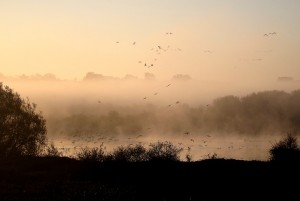
The morning was frosty and the mist made the lagoons look like they were smoking. The geese were spectacular when they crowded into the lagoons, flying silhouetted against the mist. At about 08.15, on the Slurry Lagoon the Lapwings and Black-headed Gulls suddenly rose and flew out from the reedbeds. I looked but could see no raptor. Ten minutes later a crow gave its raptor mobbing call and there was a ringtail hen harrier, its white rump flashing as it dodged the crow. Two crows pursued the harrier aggressively and drove it off so that it left the site flying north-east, but it must have spent ten minutes in the reed bed before the crows started chasing it. There were still Skylarks trickling through with a couple of Meadow Pipits, and a flock of Siskins went over. Later three Grey Wagtails passed to the south and two Golden Plovers flew in, calling loudly. The two Pintail were still on the Slurry Lagoon and a female Golden-eye was on the Deep Pit. PS.
Golden Plover – 14th October
This morning there was lots of evidence of migration at the lagoons with a constant trickle of Skylarks flying over. One or two large flocks of Fieldfares also went through and some Redwings are already in the hawthorn hedges. A flock of thirteen Lesser Redpolls dropped onto the bushes on the Deep Pit banks and one or two Siskins are still going through. On the Slurry Lagoon the two Pintail are still present, one beginning to attain the winter plumage of a male, and the Teal and Shoveler are well into developing their winter plumages too. The Lapwing flock is building up as several small flocks came in to join them. Unlike the Lapwings a flock of 18 Golden Plover flew in but decided not to land and disappeared again over the neighbouring farmland. PS.
Chiffchaff – 13th March
At last the first spring migrant has arrived. A Chiffchaff was seen in the willows along the Ouse Dyke path this morning, along with two Goldcrests and three Siskins. On the Large Gravel Pit the Golden-eyes were displaying, as were some Lapwings on the Severn/Trent land. A female Goosander was on the river and a flock of Golden Plover were heard calling from towards Stoke Bardolph. PS.
Sun Hats and Sun Cream
Padley Gorge – May 2010
On what was to be the hottest day of the year so far, Deryck, Jackie and I left Nottingham at about 0730 to meet Brian, Norman and Steve in Baslow, Derbyshire. While we waited a Garden Warbler was singing near the stream. We looked for Dipper, as this was a spot I used to see them regularly but not today.
We moved off to our first stop at Padley Gorge. We parked up, dosed up with sun cream and donned our sun hats then set off down the Gorge. Our target birds being Spotted and Pied Flycatcher and Common Redstart. It wasn’t long before Redstart was heard but not seen. Continuing down the path we soon had views of 2 pair of Redstart at two nest boxes, close to each other. A few yards on down the path we were soon enjoying views of Pied Flycatchers, again at a nest box. A few of the group went a little further down the Gorge to see if they could connect with Wood Warbler but to no avail. Cuckoo could be heard calling all round but not seen. We had good views of a Nuthatch, a Treecreeper and a Great Spotted Woodpecker. With the weather so warm there were Wood Ants all along the woodland path. Also seen were Small & Green-veined White Butterflies along with Orange Tip and Peacock. We returned to the cars, the day trip list now standing at 22 birds, 2 mammals and 4 butterfly.
We moved on about a mile to Surprise View Car Park were after a coffee break we moved onto the open moor for the first time. Here we added Tree Pipit and Carrion Crow to the day list along with a fleeting glimpse of a Green Hairstreak butterfly.
We moved on again, this time to Stanage Edge, taking a slow walk up to the edge over the open moorland. On the way we could hear a Reed Bunting calling from a gully and Curlew were heard across the moor. As we approached the Edge brilliant views of Green Hairstreak were obtained and photographed. Then the next target bird was spotted sat on a rock – a male Ring Ouzel. 3 males and a female were seen before we left the Edge. A Buzzard was seen being mobbed by Curlew.
Wearily and hot we returned to the cars to move on the Cutthroat Bridge, near the Ladybower Dams were we stopped for lunch.
After a refreshing break, another load of sun cream applied we set out on what I believed to be a steady walk around the moors. I had done a similar walk about 10 years ago and had found it very pleasant. Oh how the memory fades! The path we took was not the path I had taking all those years earlier. We were however rewarded with fine views of a Whinchat. A little further on we entered the Derbyshire Wildlife Trust reserve – Ladybower Wood. The track here was very rugged but again we were rewarded with the first sighting, on our trips, of a Grizzled Skipper. These are tiny butterflies, about 22 – 26 cms
(about 1 inch or less)that can easily be over-looked. (See article – Dingy and Grizzled Skipper) Three more were found a little further on along with a Small Copper. While in the wood a peregrine glided over the treetops.
We continued on the path past the rear of The Ladybower Inn were Jackie had a visit from a strange little creature on her camera case that Brian and Norman did their best to photograph. Jackie and I later identified it as a House Longhorn. Also in this area were a few Rose Chaffers.
While going through a conifer plantation we had views of Siskin and Goldcrest.
The path seemed to go on and on, out of the trees and on to the open moor, getting steeper all the time. We were all shattered on getting to the top but here we were rewarded with fine views of Red Grouse and two chicks. After a well-earned rest we continued down hill on a well-worn path towards the cars. On the way down Stonechat were heard but we could not locate them.
Although it had been a very hot and tiring day, all agreed that it had been worth the effort with good views of the surrounding countryside and some wonderful wildlife.
I would like to thank Neil Matthew for providing us with such a good itinerary.
The yearly trip lists now stand at: – Birds – 145 (117) : Butterflies – 8 (10)
Mammals – 6 (5) : Dragonflies – 0 (0) : Others – 3 (0)
2009 in brackets.
Peregrine – 31st October
The Willow Tit and eight Redpoll were seen along the Lower Path this morning and one or two Siskins are still flying through. All three Cetti’s were heard singing, so let’s hope they all survive the winter. A Peregrine flew over the site putting everything to flight and landed on a pylon. Two Golden Plover were seen flying around the site before departing north and a Snipe went up while 300 Lapwing eventually settled down on the Slurry Lagoon again. The goose flock on the Severn Trent land also went up and the Rossi’s Goose was spotted amongst them again. PS.
Pink-footed Goose – 20th October
This morning there were lots of signs of birds migrating through the site. Several small flocks of Fieldfares went over, with a few Redwing. Amongst the finches going over was heard a Redpoll, Siskin and Brambling, plus three Tree Sparrows went through. A Swallow flew over the Deep Pit, where a drake Golden-eye had attached itself to a small Tufty flock. The stoccato calls of about 200 Pink-footed Geese attracted my attention as they flew through to the east. PS.