Tag Archives: Garden Warbler

Lesser Scaup – 21st April

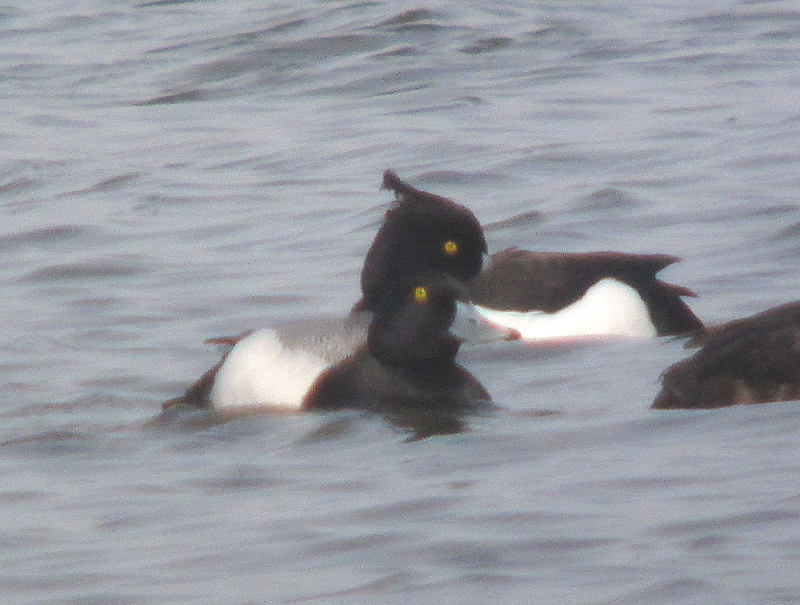
An adult male Lesser Scaup was seen today, feeding with a small flock of  Tufted Duck on the Slurry Lagoon. It was also mate guarding the only female in the flock. Also seen were Garden Warbler, Grasshopper Warbler, Lesser Whitethroat, Yellow Wagtail, Little Ringed Plover and Common Sandpiper. CH, RW.

Lesser Scaup
Lesser Scaup

In the afternoon a Cuckoo flew over the Slurry Lagoon. RW.

Warbler Walk – 9th May

 After a bright sunny morning the weather clouded over and the first raindrops were felt just as three intrepid birders arrived to start the walk. By the footbridge there were Chiffchaffs, Blackcaps and a Lesser Whitethroat, so at least the warblers were not put off by the weather.

The rain came and went in short, light showers, so the weather was not too uncomfortable, as we made our way around the south western side of the Slurry Lagoon. There were lots of birds singing, making it sometimes difficult to point out a particular species, with Dunnocks, Wrens, Blackbirds, Song Thrushes and Robins joining the singing throng. A Willow Warbler perched up nicely so that everyone could see it as it sang its sweet cadence of descending notes. More Blackcaps were singing but they were much harder to see, and another Lesser Whitethroat was rattling out its song from deep in the hawthorns. Whitethroats were heard but they were giving their ‘churring’ contact notes and the only singing bird was rather distant, so we moved on towards the Causeway, where I hoped to find Reed and Sedge Warbler.

When we arrived by the reed bed there was such a hubbub of song that again individuals were hard to pick out. Then a Sedge Warbler started to perform and its staccato notes gave us no doubt of the performer’s identity. The Reed Warblers sang much more rhythmically with a more even range of notes. None of the birds were showing as they remained deep in the dried stems of last years reeds. A Whitethroat sang briefly from the Deep Pit but gave very poor views, and the Cetti’s Warbler song exploded from the bushes at the foot of the bank several times as it made its patrol.

All of this was soon forgotten as rain brought Swifts and House Martins low and their close passes above our heads completely stole the show. They seemed to go through in waves as first there were Swifts rocketing over the Causeway at head height, and then the House Martins could be heard giving their conversational ‘prrit’ calls as thirty or so were feeding higher up. Next some Swallows came though and then it was House Martins again. During this time the Swifts kept coming though, sometimes passing between peoples’ heads and Common Terns flew between the Deep Pit and Slurry Lagoon several times, calling excitedly as they pursued one that was carrying a fish. The Swifts were so impressive that it took us a long time before we could drag ourselves away.

We walked around the Deep Pit and back along its eastern side towards the river. On the bank by the river there were two Sedge Warblers singing loudly and a good view was grabbed of a male Whitethroat. On the fence we noticed some Swallows having a rest, so we paused until they decided to continue their journey, which was not very long. We tried to identify the males from the females. Some Sand Martins were feeding in the Deep Pit and we heard their rasping ‘trrrsh’ calls as some flew over towards the river. We carried on back towards the Causeway, hearing Willow Warblers, Chiffchaffs and Blackcaps singing along the railway embankment. Back on the Causeway we struck lucky as a Garden Warbler bubbled through its repertoire as it sat on an exposed perch and everybody got good views of it. The Swifts were still performing well, so we dawdled along the Causeway, hearing the Cetti’s Warbler again. It now began to rain more seriously and so we made our way off the site. We had missed one of the warblers, so we only scored nine. The Grasshopper Warbler has only been heard once or twice, very briefly, and is possibly not even on site this year.

Warbler Walk – 9th May

 After a bright sunny morning the weather clouded over and the first raindrops were felt just as three intrepid birders arrived to start the walk. By the footbridge there were Chiffchaffs, Blackcaps and a Lesser Whitethroat, so at least the warblers were not put off by the weather.

The rain came and went in short, light showers, so the weather was not too uncomfortable, as we made our way around the south western side of the Slurry Lagoon. There were lots of birds singing, making it sometimes difficult to point out a particular species, with Dunnocks, Wrens, Blackbirds, Song Thrushes and Robins joining the singing throng. A Willow Warbler perched up nicely so that everyone could see it as it sang its sweet cadence of descending notes. More Blackcaps were singing but they were much harder to see, and another Lesser Whitethroat was rattling out its song from deep in the hawthorns. Whitethroats were heard but they were giving their ‘churring’ contact notes and the only singing bird was rather distant, so we moved on towards the Causeway, where I hoped to find Reed and Sedge Warbler.

When we arrived by the reed bed there was such a hubbub of song that again individuals were hard to pick out. Then a Sedge Warbler started to perform and its staccato notes gave us no doubt of the performer’s identity. The Reed Warblers sang much more rhythmically with a more even range of notes. None of the birds were showing as they remained deep in the dried stems of last years reeds. A Whitethroat sang briefly from the Deep Pit but gave very poor views, and the Cetti’s Warbler song exploded from the bushes at the foot of the bank several times as it made its patrol.

All of this was soon forgotten as rain brought Swifts and House Martins low and their close passes above our heads completely stole the show. They seemed to go through in waves as first there were Swifts rocketing over the Causeway at head height, and then the House Martins could be heard giving their conversational ‘prrit’ calls as thirty or so were feeding higher up. Next some Swallows came though and then it was House Martins again. During this time the Swifts kept coming though, sometimes passing between peoples’ heads and Common Terns flew between the Deep Pit and Slurry Lagoon several times, calling excitedly as they pursued one that was carrying a fish. The Swifts were so impressive that it took us a long time before we could drag ourselves away.

We walked around the Deep Pit and back along its eastern side towards the river. On the bank by the river there were two Sedge Warblers singing loudly and a good view was grabbed of a male Whitethroat. On the fence we noticed some Swallows having a rest, so we paused until they decided to continue their journey, which was not very long. We tried to identify the males from the females. Some Sand Martins were feeding in the Deep Pit and we heard their rasping ‘trrrsh’ calls as some flew over towards the river. We carried on back towards the Causeway, hearing Willow Warblers, Chiffchaffs and Blackcaps singing along the railway embankment. Back on the Causeway we struck lucky as a Garden Warbler bubbled through its repertoire as it sat on an exposed perch and everybody got good views of it. The Swifts were still performing well, so we dawdled along the Causeway, hearing the Cetti’s Warbler again. It now began to rain more seriously and so we made our way off the site. We had missed one of the warblers, so we only scored nine. The Grasshopper Warbler has only been heard once or twice, very briefly, and is possibly not even on site this year.

Marsh Harrier – 4th May

There was a good arrival of migrants over the last two days with warbler numbers shooting up. The reed beds hold several Reed and Sedge Warblers and several Lesser Whitethroats and Garden Warblers have arrived. Swallows, House Martins and Swifts have been passing through in good numbers all day. In the morning a Curlew flew over the site and a Little Egret made an appearance. In the late afternoon a Marsh Harrier flew in and possibly stayed to roost in the Slurry Lagoon reed bed. RW.

Garden Warbler – 2nd May

A Garden Warbler was feeding and calling in bushes close to the Ouse Dyke bridge early afternoon. JMD.

A second Garden Warbler was singing and showing well by the riverside, and two Cuckoos were heard calling. The warm weather also tempted some butterflies out and 5 Brimstones, 11 Orange Tips and 8 Green-veined Whites were counted. PS.

Black Tern – 30th April

This afternoon there were signs that some more migrants had arrived with four Lesser Whitethroats in song. There were still no Garden Warblers or Grasshopper Warblers but in the Deep Pit a Black Tern was hawking for insects. It had a very buoyant flight as it rose above the water, flying into the wind. When it spotted an insect it dived like a falcon, probably catching a St. Marks Fly. There was a Lesser Black-backed Gull on the Slurry Lagoon and two Shelduck, but no sign of any Teal. PS.

Sun Hats and Sun Cream

Padley Gorge – May 2010

On what was to be the hottest day of the year so far, Deryck, Jackie and I left Nottingham at about 0730 to meet Brian, Norman and Steve in Baslow, Derbyshire. While we waited a Garden Warbler was singing near the stream. We looked for Dipper, as this was a spot I used to see them regularly but not today.

We moved off to our first stop at Padley Gorge. We parked up, dosed up with sun cream and donned our sun hats then set off down the Gorge. Our target birds being Spotted and Pied Flycatcher and Common Redstart. It wasn’t long before Redstart was heard but not seen. Continuing down the path we soon had views of 2 pair of Redstart at two nest boxes, close to each other. A few yards on down the path we were soon enjoying views of Pied Flycatchers, again at a nest box. A few of the group went a little further down the Gorge to see if they could connect with Wood Warbler but to no avail. Cuckoo could be heard calling all round but not seen. We had good views of a Nuthatch, a Treecreeper and a Great Spotted Woodpecker. With the weather so warm there were Wood Ants all along the woodland path. Also seen were Small & Green-veined White Butterflies along with Orange Tip and Peacock. We returned to the cars, the day trip list now standing at 22 birds, 2 mammals and 4 butterfly.

We moved on about a mile to Surprise View Car Park were after a coffee break we moved onto the open moor for the first time. Here we added Tree Pipit and Carrion Crow to the day list along with a fleeting glimpse of a Green Hairstreak butterfly.

We moved on again, this time to Stanage Edge, taking a slow walk up to the edge over the open moorland. On the way we could hear a Reed Bunting calling from a gully and Curlew were heard across the moor. As we approached the Edge brilliant views of Green Hairstreak were obtained and photographed. Then the next target bird was spotted sat on a rock – a male Ring Ouzel. 3 males and a female were seen before we left the Edge. A Buzzard was seen being mobbed by Curlew.

Wearily and hot we returned to the cars to move on the Cutthroat Bridge, near the Ladybower Dams were we stopped for lunch.

After a refreshing break, another load of sun cream applied we set out on what I believed to be a steady walk around the moors. I had done a similar walk about 10 years ago and had found it very pleasant. Oh how the memory fades! The path we took was not the path I had taking all those years earlier. We were however rewarded with fine views of a Whinchat. A little further on we entered the Derbyshire Wildlife Trust reserve – Ladybower Wood. The track here was very rugged but again we were rewarded with the first sighting, on our trips, of a Grizzled Skipper. These are tiny butterflies, about 22 – 26 cms

(about 1 inch or less)that can easily be over-looked. (See article – Dingy and Grizzled Skipper) Three more were found a little further on along with a Small Copper. While in the wood a peregrine glided over the treetops.

We continued on the path past the rear of The Ladybower Inn were Jackie had a visit from a strange little creature on her camera case that Brian and Norman did their best to photograph. Jackie and I later identified it as a House Longhorn. Also in this area were a few Rose Chaffers.

While going through a conifer plantation we had views of Siskin and Goldcrest.

The path seemed to go on and on, out of the trees and on to the open moor, getting steeper all the time. We were all shattered on getting to the top but here we were rewarded with fine views of Red Grouse and two chicks. After a well-earned rest we continued down hill on a well-worn path towards the cars. On the way down Stonechat were heard but we could not locate them.

Although it had been a very hot and tiring day, all agreed that it had been worth the effort with good views of the surrounding countryside and some wonderful wildlife.

I would like to thank Neil Matthew for providing us with such a good itinerary.


The yearly trip lists now stand at: – Birds – 145 (117) : Butterflies – 8 (10)

Mammals – 6 (5) : Dragonflies – 0 (0) : Others – 3 (0)

2009 in brackets.
Lincolnshire 2010

After having picked up various passengers the two cars left Nottingham at about 8.15 am and we made our way to Whisby Nature Park near Lincoln for 9.15 am were we met up with Jack Driver. The early rain that fell on Nottinghamshire was now falling on Lincolnshire so we donned our waterproofs and set off to find our target bird of the day – Nightingale.

According to the sightings board there were six singing males on the site. Looking on the nearest lake Pete found a pair of Little Ringed Plovers changing over nest duties while in the background a Nightingale was singing. A Sparrowhawk shot past the group so fast that not all of us managed to see it. We looked for the singing Nightingale without success so it was decided to go to the area where I had seen them on previous visits.

Having turned the corner at the northern end of Coot Lake we were deafened as one was singing very close to the path and it wasn’t long before Pete had found it. What a stunning bird – in full view. The problem was that not all the group had seen it and nobody had brought a camera as it was thought that they would only be heard and not seen.

We moved on, hearing three or four more before Pete again located one competing with a very high pitched Grasshopper Warbler, that not all the group could hear, and a Garden Warbler. The Nightingale was about 50 metres away over the railway. After watching the Nightingale I decided that I would leave the group and see if I could see or hear the Grasshopper Warbler on my own. I managed, after a few minutes, to get a short snatch of its song before the Nightingale drowned it out again. We made our way back to the car park, the sun shining now. Three Nightingale were seen with at least a further five heard.

With the trip list now standing at 26 we said our goodbyes to Jack Driver and made our way to RSPB Frampton near Boston, seeing Red-legged Partridge and Hare on the way.

The first birds seen at Frampton were a pair of Black Swans, obviously escaped from a collection but seemed to be doing well in the wild. We were surprised to see that the Brent Geese were still in the area as we had expected them to have gone to their breeding grounds by now. After a break for lunch and a cuppa we set off down the path towards the hides. On a small tree a Corn Bunting was singing while a Whimbrel was seen to land on the wet meadow. Steve spotted a Stoat as it ran from the meadow and over the road – our second mammal of the day. As it tried to rain again we made our way towards the first hide but stopped again as a photogenic Corn Bunting sat on a post for us. As we were about to go into the hide several Twite were seen on the wires. In all we counted 15. We were told that during the winter there were several hundred on the reserve. Also seen from the hide were two White Wagtail, Ruff and Black-tailed Godwit. Meadow Pits were singing as we left the hide to go back to the cars. Jackie spotted a female Wheatear on a fence post. From the car park I looked at the Barn Owl box through my binoculars and thought I saw part of the face of the Barn Owl. Sure enough as soon as a telescope was trained on the box the head of the bird could be seen. We were doing well as we had seen 63 species on the day.

We made our way north of Boston to Freiston RSPB reserve. Upon arriving we noticed a Pale-bellied Brent Goose in among the Dark-bellied. Although only a sub-species I would not be surprised if it is not split in a few years time to be a species in its own right.

We made our way to the sea wall as high tide was due at about 4.00 pm. The tide didn’t cover the marsh but birds were being moved all the while giving reasonable views of Knot, Eider, Curlew and Grey Plover. A Peregrine was seen as were two Fulmar. Near the car park the fields were scanned and Jackie spotted a fairly distant Yellow Wagtail.

Overall 81 bird species were seen taking the year’s list to 137 compared with 102 this time last year. The mammal list is at 6 (5 in 2009). Only one butterfly has been seen that of a Large White. This time last year 8 had been seen.