Tag Archives: Whitethroat

Warbler Walk – 9th May

 After a bright sunny morning the weather clouded over and the first raindrops were felt just as three intrepid birders arrived to start the walk. By the footbridge there were Chiffchaffs, Blackcaps and a Lesser Whitethroat, so at least the warblers were not put off by the weather.

The rain came and went in short, light showers, so the weather was not too uncomfortable, as we made our way around the south western side of the Slurry Lagoon. There were lots of birds singing, making it sometimes difficult to point out a particular species, with Dunnocks, Wrens, Blackbirds, Song Thrushes and Robins joining the singing throng. A Willow Warbler perched up nicely so that everyone could see it as it sang its sweet cadence of descending notes. More Blackcaps were singing but they were much harder to see, and another Lesser Whitethroat was rattling out its song from deep in the hawthorns. Whitethroats were heard but they were giving their ‘churring’ contact notes and the only singing bird was rather distant, so we moved on towards the Causeway, where I hoped to find Reed and Sedge Warbler.

When we arrived by the reed bed there was such a hubbub of song that again individuals were hard to pick out. Then a Sedge Warbler started to perform and its staccato notes gave us no doubt of the performer’s identity. The Reed Warblers sang much more rhythmically with a more even range of notes. None of the birds were showing as they remained deep in the dried stems of last years reeds. A Whitethroat sang briefly from the Deep Pit but gave very poor views, and the Cetti’s Warbler song exploded from the bushes at the foot of the bank several times as it made its patrol.

All of this was soon forgotten as rain brought Swifts and House Martins low and their close passes above our heads completely stole the show. They seemed to go through in waves as first there were Swifts rocketing over the Causeway at head height, and then the House Martins could be heard giving their conversational ‘prrit’ calls as thirty or so were feeding higher up. Next some Swallows came though and then it was House Martins again. During this time the Swifts kept coming though, sometimes passing between peoples’ heads and Common Terns flew between the Deep Pit and Slurry Lagoon several times, calling excitedly as they pursued one that was carrying a fish. The Swifts were so impressive that it took us a long time before we could drag ourselves away.

We walked around the Deep Pit and back along its eastern side towards the river. On the bank by the river there were two Sedge Warblers singing loudly and a good view was grabbed of a male Whitethroat. On the fence we noticed some Swallows having a rest, so we paused until they decided to continue their journey, which was not very long. We tried to identify the males from the females. Some Sand Martins were feeding in the Deep Pit and we heard their rasping ‘trrrsh’ calls as some flew over towards the river. We carried on back towards the Causeway, hearing Willow Warblers, Chiffchaffs and Blackcaps singing along the railway embankment. Back on the Causeway we struck lucky as a Garden Warbler bubbled through its repertoire as it sat on an exposed perch and everybody got good views of it. The Swifts were still performing well, so we dawdled along the Causeway, hearing the Cetti’s Warbler again. It now began to rain more seriously and so we made our way off the site. We had missed one of the warblers, so we only scored nine. The Grasshopper Warbler has only been heard once or twice, very briefly, and is possibly not even on site this year.
Warbler Walk – 9th May

 After a bright sunny morning the weather clouded over and the first raindrops were felt just as three intrepid birders arrived to start the walk. By the footbridge there were Chiffchaffs, Blackcaps and a Lesser Whitethroat, so at least the warblers were not put off by the weather.

The rain came and went in short, light showers, so the weather was not too uncomfortable, as we made our way around the south western side of the Slurry Lagoon. There were lots of birds singing, making it sometimes difficult to point out a particular species, with Dunnocks, Wrens, Blackbirds, Song Thrushes and Robins joining the singing throng. A Willow Warbler perched up nicely so that everyone could see it as it sang its sweet cadence of descending notes. More Blackcaps were singing but they were much harder to see, and another Lesser Whitethroat was rattling out its song from deep in the hawthorns. Whitethroats were heard but they were giving their ‘churring’ contact notes and the only singing bird was rather distant, so we moved on towards the Causeway, where I hoped to find Reed and Sedge Warbler.

When we arrived by the reed bed there was such a hubbub of song that again individuals were hard to pick out. Then a Sedge Warbler started to perform and its staccato notes gave us no doubt of the performer’s identity. The Reed Warblers sang much more rhythmically with a more even range of notes. None of the birds were showing as they remained deep in the dried stems of last years reeds. A Whitethroat sang briefly from the Deep Pit but gave very poor views, and the Cetti’s Warbler song exploded from the bushes at the foot of the bank several times as it made its patrol.

All of this was soon forgotten as rain brought Swifts and House Martins low and their close passes above our heads completely stole the show. They seemed to go through in waves as first there were Swifts rocketing over the Causeway at head height, and then the House Martins could be heard giving their conversational ‘prrit’ calls as thirty or so were feeding higher up. Next some Swallows came though and then it was House Martins again. During this time the Swifts kept coming though, sometimes passing between peoples’ heads and Common Terns flew between the Deep Pit and Slurry Lagoon several times, calling excitedly as they pursued one that was carrying a fish. The Swifts were so impressive that it took us a long time before we could drag ourselves away.

We walked around the Deep Pit and back along its eastern side towards the river. On the bank by the river there were two Sedge Warblers singing loudly and a good view was grabbed of a male Whitethroat. On the fence we noticed some Swallows having a rest, so we paused until they decided to continue their journey, which was not very long. We tried to identify the males from the females. Some Sand Martins were feeding in the Deep Pit and we heard their rasping ‘trrrsh’ calls as some flew over towards the river. We carried on back towards the Causeway, hearing Willow Warblers, Chiffchaffs and Blackcaps singing along the railway embankment. Back on the Causeway we struck lucky as a Garden Warbler bubbled through its repertoire as it sat on an exposed perch and everybody got good views of it. The Swifts were still performing well, so we dawdled along the Causeway, hearing the Cetti’s Warbler again. It now began to rain more seriously and so we made our way off the site. We had missed one of the warblers, so we only scored nine. The Grasshopper Warbler has only been heard once or twice, very briefly, and is possibly not even on site this year.
Greenshank – 4th September

This morning there were lots of warblers along the Lower Path and in the Deep Pit, including several Lesser Whitethroat, Whitethroat, Blackcap, Reed Warbler and Chiffchaff. On the Slurry Lagoon there were two Little Ringed Plover, two Snipe, two Greenshank and two Little Egrets. PS.AE.CH.RW.

In the early afternoon a Clouded Yellow was seen on the east bank of the Deep Pit, near the seat. RW.

Waxwings – 7th April

This afternoon there were plenty of signs of summer migrants arriving as five Swallows were at their breeding site, under the railway bridge. There were three Common Terns on the tern platforms and several Whitethroats singing from the brambles. Two Sedge Warblers were heard, singing from deep cover and dozens of Sand Martins were feeding over the pits. Despite all these signs of the burgeoning spring the unmistakable trilling of Waxwings was heard and a flock of about forty flew across the river by the railway bridge.

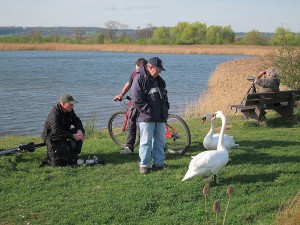
Friends greet each other on the Causeway.

Migrants Return – 3rd April

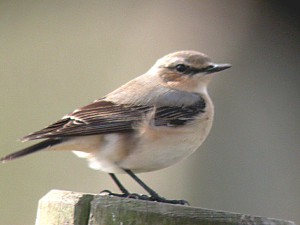
During the last few days many migrant  species have been returning to the lagoons and helped to provide a quite exciting morning’s watching in very pleasant bright weather this morning. Amongst others, the Sand Martins are now present in considerable numbers on the river bank. Willow Warblers were noted in several locations, as were Chiffchaffs and one or two Blackcaps. A single Reed Warbler was heard in the Deep Pit and a Whitethroat in the  brambles on the Slurry Lagoon. The highlight of the morning was a Wheatear, which perched very close on fence posts, and the close second was the appearance of three Buzzards, which displayed well, including an aerial fight. The Cetti’s Warbler was in good voice also.

Meanwhile two Common Terns were struggling with Black-headed Gulls for space on the tern platform.

Butterflies, including Small Tortoiseshell, Peacock, Comma, and  Red Admiral were noted and the Blackthorn Blossom was a sight  to see (and  smell). A Yellow Wagtail was also seen over the Large Gravel Pit and six Shelduck flew into the Slurry Lagoon.

PS/NM/RW/AR/ DG/LD/AE

Spotted Flycatcher – 22nd August

This morning as we walked along the Lower Path four Jays sneaked into the canopy of the ash trees while a a Buzzard called overhead. There were several immature Reed Warblers, Sedge Warblers, Blackcaps and Whitethroats and a Lesser Whitethroat and Willow Tit in the bushes between the path and the railway line. Near to the signal box a Spotted Flycatcher was perched on the wires and then in the hawthorn bushes, and a Stoat ran across the path. By the river the Swallows’ alarm calls alerted us to a Hobby. PS.

A Little Egret was seen briefly on the Slurry Lagoon and several Roesel’s Bush-crickets were found on the Causeway. By the Small Gravel Pit an Emperor, Migrant Hawker, Brown Hawker and Common Darter were seen. PS.