The juvenile Mediterranean Gull was on the Slurry Lagoon again this afternoon, along with a Snipe and juvenile Wigeon. Two Hobbies and a Buzzard were also seen. JMD. PS.
All posts by Pete Smith
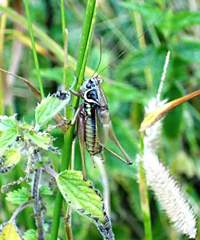
Roesel’s Bush Cricket – 9th August
There seemed to be more insect activity today than bird. Several Long-winged Coneheads were found including a mature male. There were also plenty of butterflies and dragonflies.
Ant Swarm – 8th August
During the Bird Count this morning there was an ant swarm that attracted a flock of over 500 Black-headed Gulls. There were also some Common Terns catching the ants and three Hobbies. Two Curlews stopped briefly on the Slurry Lagoon and a Green Sandpiper was amongst the Lapwings. A Little Egret was on the Large Gravel Pit with some Grey Herons and about twenty Cormorants, before joining the gulls on the Slurry Lagoon. Several Roesel’s Bush Crickets and Long-winged Coneheads were also found. On the Lower Path five Brimstones were found along with Commas, Red Admiral and Peacocks. PS.

- Gulls and ant swarm
Watch Alan’s video:
httpv://www.youtube.com/watch?v=rKYnvqGQAm4
Black-tailed Godwit – 2nd August
There were three Black-tailed Godwits, five Dunlin, five Yellow-legged Gulls and a Caspian Gull on the Slurry Lagoon this afternoon. Both Roesel’s Bush Crickets and Long-winged Coneheads were found and a Willow Tit was heard along the Lower Path. PS.
In the evening a juvenile Mediterranean Gull, three Green Sandpipers, a Snipe and a Water Rail were present on the Slurry Lagoon. RW.
Roesel’s Bush Cricket – 1st August
A Roesel’s Bush Cricket was found today, also a Small Red-eyed Damselfly and Emerald Damselfly on the Small Gravel Pit. On the Slurry Lagoon was one Greenshank and two Green Sandpipers and a Peregrine was also seen. RW.
Butterfly/Dragonfly Walks – 28th July and 1st August
Both of these walks were quite well attended with six and ten people turning up at each, respectively. Despite the weather being overcast on both occasions the air was warm and the insects showed in sheltered spots. When the sun did briefly shine it warmed up incredibly quickly and insect activity increased.
On the first walk, as I had seen a Southern Hawker on the way to meet the group I took them first along Willow Walk, but unfortunately we did not see it although we did find Gatekeepers, Large Whites and a Speckled Wood. Along the Lower Path we came to grips with Large White, Small White and Green-veined Whites, looking at each species in a book and comparing their markings so that most people soon had no trouble identifying their Whites. There were very few Ringlets and Meadow Browns about but plenty of Gatekeepers. All along the Lower Path there were abundant Common Blue Damselflies and just one or two Blue-tailed Damselflies and, near the ‘Irish Bridge’ we found a Brown Hawker. We walked around the banks and found some Common Blue butterflies and there were dozens of Six-spot Burnet cocoons attached to the wire of the Deep Pit fence. We walked back along the north east side of the Slurry Lagoon and found some Small Skippers and one Essex Skipper and the Long-winged Coneheads were thick in the grass, which gave people a foretaste of the Cricket and Grasshopper walks. We gave the Willow Walk and Southern Hawker another try before finishing and the dragonfly was obliging, giving prolonged close views as it patrolled its patch.
The Sunday walk was slightly more successful as the sun came out more and there was more butterfly activity. On the Lower Path we were surprised to see a Weasel that was hunting along the path and coming towards us. It kept darting off the path to one side or the other and reappearing again. As the morning warmed up more butterflies emerged and a splendid Red Admiral was seen, followed by several Peacocks and Commas. This time the ‘Irish Bridge’ gave up a Migrant Hawker and three Brown Hawkers were seen as we followed the path. Several times we were distracted by the numbers and variety of the hoverflies along this walk especially when one or two exceptionally large species were seen. Near the river two Small Tortoiseshells were feeding on the Creeping Thistle flowers. As it was fairly warm we went to the Small Gravel Pit to see what activity there was and found several damselflies emerging from their larval skins and clinging to the reeds. Other Common Blue Damselflies were egg laying, some females going right under the water to lay on vegetation. A Black-tailed Skimmer landed on the beach in front of us as we watched the emerging damselfly nymphs and one or two Blue-tailed Damselflies were also seen. We walked back around the Deep Pit and there were a lot more Common Blue butterflies about than on the previous walk and we finished the walk looking at the Long-winged Coneheads again.
Hobby – 30th July
A Hobby was watched for ten minutes this afternoon trying to catch a Swallow by the railway bridge. In the end it gave up and flew towards Holme Pierrepont. On the Slurry Lagoon there was a Greenshank and a Redshank plus three Yellow-legged Gulls. PS.
Greenshank – 26th July
This afternoon on the Slurry Lagoon there was a Greenshank, a Green Sandpiper and a probable Caspian Gull. Most of the terns had gone with only one present on one of the breeding platforms for part of the afternoon. RW, PS.
Little Egret – 22nd July
On the Slurry Lagoon this afternoon there were one Little Egret, 43 Common Tern, 102 Lapwing, one Common Sandpiper, two Green Sandpipers, two Yellow-legged Gulls and a Water Rail. RW.
Dunlin – 18th July
Two Dunlin were on the Slurry Lagoon this morning as well as a Yellow Wagtail and five Yellow-legged Gulls amongst the Lesser Black-back flock. At least fifteen Long-winged Coneheads were by the path at the NW corner of the Slurry Lagoon. PS. AE.