Amongst the gulls roosting on the Slurry Lagoon this afternoon an adult Caspian Gull was found, as well as a Yellow-legged Gull. There were twelve White-fronted Geese which circled the lagoon before coming down across the river to land with the goose flock. Later some of them came onto the Slurry Lagoon with the other geese to roost. Also on the Slurry Lagoon were four Pintail and two Little Egrets. The Starling roost contained at least 3,000 birds and was predated by a Sparrowhawk and a possible Merlin and at least eight Water Rails were either seen or heard. RW. PS.
Category Archives: Recent wildlife sightings
White-fronted Goose – 15th November
This evening, as the Grey-lag and Canada Geese flew in to roost on the Slurry Lagoon, a softer, more musical note was heard amongst the other, more raucous calls. Five, smaller geese came in and landed. In the poor light the white blaze of a White-fronted Goose could be seen on one of them, but not the others, and they are probably one adult and four juveniles. Several hundred more Grey-lag and Canada Geese came in but the White-fronts kept slightly apart, and then the calls of two more were heard as they joined the other five. Unfortunately it was too dark by this time to see if they were adult or juvenile. Also present were a Little Egret, a Shelduck, two Yellow-legged Gulls and several Water Rails. PS, RW, TK.
Starlings – 9th November
This evening, at the Starling roost, a strange, pale individual was noticed, raising hopes of a Rose-coloured Starling. Unfortunately better views showed that its wings and tail were paler than its body, making a leucistic variant more likely. There was also an aberrant Lesser Black-backed Gull, which JMD managed to photograph. PS.

Rock Pipit – 7th November
A Rock Pipit paused briefly on the Slurry Lagoon this afternoon, where there were also three Dunlins and a Little Egret and later, an adult Yellow-legged Gull. The Pintail is still on the Large Gravel Pit. RW.
Mediterranean Gull – 3rd November
The gull roost contained a first winter Mediterranean Gull and an adult Yellow-legged Gull this afternoon. Several Water Rails were heard or seen across the site, as were hunting Sparrowhawks. One Sparrowhawk was seen to fly into the Starling roost causing them to move across the Slurry Lagoon to another reed bed. As the light failed a massive flock of Grey-lag Geese rose unseen from the harvested maize field, where they had been feeding, to move to the Large Gravel Pit, to roost. The noise they made cackling and screeching was very impressive. RW, PS.
Little Egret – 2nd November
A Little Egret was on the Slurry Lagoon late afternoon but flew away after unsuccessfully trying to see the Lapwings off. The male Pintail is still present and he seems to commute between the Large Gravel Pit and the Slurry Lagoon. The Starling roost was spectactular again with thousands of birds gathering on two particular pylons before coming in waves to roost in the Slurry reed bed. JMD.
Starling – 31st October
As the light dimmed, at about 16.15, the Starlings began to arrive to roost. A group of about 1,000 formed and did an aerial display, then decided to have a mass bathe amongst the gull roost. Another group of about 1,000 arrived and then both groups amalgamated and smoked into the reed bed. Then lots of smaller groups of fifty to 200 birds arrived, mostly from the east and dived spectacularly into the reed beds to join the others. This carried on for about thirty minutes until I estimated about 4,500 birds were in the roost. Whilst this was happening there were echelons of Grey-lag and Canada Geese arriving to roost on the Large Gravel Pit and the numbers grew to about 1,200 Grey-lag and about 800 Canadas. On the Slurry Lagoon the gull roost reached in excess of 1,000 birds but the light did not make counting them practical. A Water Rail flew across the gap in the reed beds in front of the bench and the Cetti’s was in good voice. PS.
Little Egret – 28th October
A Little Egret was seen briefly a couple of times this afternoon flying in and out of the Ouse Dyke and at least two Cetti’s Warblers were heard. JMD & RD.
Brambling – 25th October
This afternoon there were two Dunlin feeding amongst the Lapwings and gull flock on the Slurry Lagoon. One Lesser Redpoll flew over and two Bramblings flew up from the hedgerow beside the Ouse Dyke. PS.
Hen Harrier – 15th October
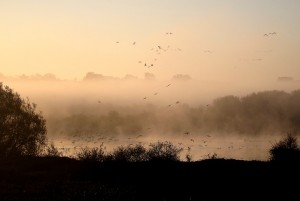
The morning was frosty and the mist made the lagoons look like they were smoking. The geese were spectacular when they crowded into the lagoons, flying silhouetted against the mist. At about 08.15, on the Slurry Lagoon the Lapwings and Black-headed Gulls suddenly rose and flew out from the reedbeds. I looked but could see no raptor. Ten minutes later a crow gave its raptor mobbing call and there was a ringtail hen harrier, its white rump flashing as it dodged the crow. Two crows pursued the harrier aggressively and drove it off so that it left the site flying north-east, but it must have spent ten minutes in the reed bed before the crows started chasing it. There were still Skylarks trickling through with a couple of Meadow Pipits, and a flock of Siskins went over. Later three Grey Wagtails passed to the south and two Golden Plovers flew in, calling loudly. The two Pintail were still on the Slurry Lagoon and a female Golden-eye was on the Deep Pit. PS.