The first of the juvenile Common Terns has made it onto the Slurry Lagoon. It was expertly picking insects from the waters surface while its parents were aggressively attacking passing crows. The Gadwall duck still had all eleven of her ducklings with her. Also present were a pair of Teal and now two male Wigeon. PS.
All posts by Pete Smith
Orchid Walk – 11th June
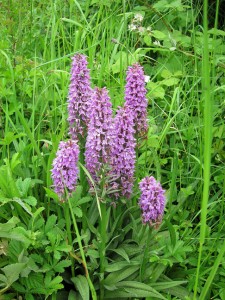
A group of us enjoyed a walk at Netherfield Lagoons looking at the orchids this Saturday morning. Despite the odd, dodgy looking cloud, the weather stayed fine as we ambled around the site. The scrub clearance along the northern bank of the Slurry Lagoon has been successful. We saw some lovely displays of Common Spotted Orchid (Dactylorhiza fuchsii). One or two of them were pure white whilst others were hybrids with the Southern Marsh Orchid (Dactylorhiza praetermissa), their flowers being a slightly darker pink and their leaves showing variation in the extent of spotting. There was a fine specimen of Southern Marsh Orchid, with no spots on the leaves and two large spikes of quite deep pink flowers. However, they still weren’t really dark pink/magenta enough to be totally ‘pure’ Southern Marsh Orchid, but who cares, they were magnificent!
We next walked along the Causeway to see the Pyramidal Orchid (Anacamptis pyramidalis), which was beginning to bloom with two beautifully pink spikes. It was then on to the end of the Causeway to look for Bee Orchids (Ophrys apifera). We checked the usual area on the outer bank of the Deep Pit and found a few specimens in flower, once we’d got our ‘eyes in’ so to speak. They are hard to spot, but once you’ve seen one you can usually find a few more nearby. We continued to look for them as we wandered around the Deep Pit and found a few small colonies scattered along the banks, but you have to look hard to find them.
Also along this bank are the Northern Marsh Orchids (Dactylorhiza purpurella), which Dave Wood found last year. We had a good look at these smaller marsh orchids, with deep magenta flowers, through our binoculars to save us all climbing the fence but none of us could be 100% sure of their identification, despite having a variety of botanical books to consult!
It was then on to the Small Gravel Pit to admire the new information board and dipping platform, before heading home. It was an enjoyable way to spend a Saturday morning.
Pochard – 11th June
This afternoon a female Pochard was seen on the Slurry Lagoon with seven ducklings. There is also a Gadwall with eleven ducklings. There were three Red-tipped Clearwings, a Meadow Brown, a Four-spotted Chaser and a Black-tailed Skimmer RW.
The Orchid Walk went well and several more Bee Orchids were found. JC.
Spotted Orchids – 9th June
The Spotted Orchids are showing well now and are flowering all over the site. The dry spring may well have affected them as the flower spikes are a little smaller than usual. The Marsh Orchids are beginning to go over now but the Spotted/Marsh hybrids are looking very strong. Unfortunately the Bee Orchids have crashed this year and I have only managed to find about nine plants so far. The Pyramidal Orchids are also down on previous years. PS.
Dunlin – 30th May
This morning the rain persuaded some passing waders to pause on the Slurry Lagoon. Four Dunlin and three Ringed Plover were feeding on the exposed mud. Nine species of warbler were seen or heard and several were feeding fledglings and there were fledgling Swallows by the railway bridge. PS. AE.
Marsh Orchids – 26th May
Several Marsh Orchids and some hybrid Marsh/Spotted Orchids are already out in several parts of the reserve. The other orchids are not so visible. PS.
Bat Patrol – 21st May
Saturday evening was very windy and over cast, not auspicious for an evening watching bats. However, twelve people met at 20.30 by the iron gates, complete with binoculars, torches and bat detectors, and we made our way onto the site, seeing a fox on the way. We had at least an hour to spend before sunset and the emergence of the bats, so the plan was to see what other crepuscular wildlife was about. We made our way to the Causeway to listen for the already departed Nightingale (just in case) and then made our way round to the north east corner of the Deep Pit, by the bench, to look out for the Barn Owl. On the way we saw lots of small groups (probably family parties) of Starlings, dropping into one patch of the Slurry Lagoon reed bed. The top of the nearby pylon was covered with Starlings and groups detatched themselves to glide down to the reed bed and dive in.
We waited for some time but there was no sign of the Barn Owl, but we did see a Rabbit. The wind was not dropping but the Swifts were hunting over the site, some swooping very close to us, and we looked out for a Noctule amongst them, as I have seen them in the past. As we waited, a hawkeyed Alan Edge said, “A badger !” and, to everybodies amazement, a Badger came up the bank from the Gravel Pits, ambled across the path and, when it saw us, bounded into the Deep Pit. That was my first sighting of a Badger on the site and the highlight of the evening.
The light was beginning to go so we made our way to the river, by the railway bridge, and switched on the bat detectors. Almost at once what was probably a Daubenton’s Bat was picked up, but it flew away and wasn’t picked up again. Instead the deafening clicks of a Noctule were heard and some managed to see it above the bridge against the last of the light in the sky. On past visits, in calmer weather, the air above the river has been full of swarms of flying insects, but tonight the wind had either blown them away or put them off coming out, so there was little to entice the bats. We waited a bit longer but only picked up the Noctule or Noctules and so decided to try our luck in the comparative shelter along the Lower Path. By the Irish Bridge we detected Common Pipistrelles and again by the Car Park, inside the metal gates. Steve Wilkinson managed to shine his torch on some so that everybody heard the call on the bat boxes and saw the eratic nature of its flight as it flew in a circuit above us.
At about 22.30 we left the site, everybody very pleased with the sighting of the Badger. We had in fact seen more species of mammal in one visit than any of us are normally privileged to do, so the evening was a definate success.
Little Ringed Plover – 17th May
The Little Ringed Plover was back, displaying over the dry end of the Slurry this afternoon. Later it was seen feeding at the wet end. The pair of Yellow Wagtails were on the Causeway again and a Grasshopper Warbler was singing at the back of the Gravel Pits. PS.
Nightingale – 15th May
This morning the brief, but distinct, notes of a Nightingale were heard coming from a bushy willow in the north end of the Deep Pit. It sang very sporadically and did not show at all. There were also all ten species of warbler singing and lots of Swifts swooping and screaming overhead. On the river there were two Oystercatchers and a Grey Wagtail while two Yellow Wagtails were seen on the Causeway. There are already some Marsh Orchids in flower. PS.
Little Ringed Plover – 13th May
A sudden downpour this afternoon produced three Little Ringed Plovers on the Slurry Lagoon. For a while they were feeding on the shoreline and then one started to fly over the lagoon calling in a display flight. Soon the other two joined it and all three were calling as they gained height and continued their journey. PS.