Two Hobbies were briefly seen flying together over the site. Also seen were a Sparrowhawk flying over and four Snipe lurking in the edge of the reeds on the slurry lagoon.
Monthly Archives: August 2009
Water Rail – 25th August
A Water Rail was weaving it’s way in and out of the reeds at the back of the Slurry Lagoon mid morning.
Yellow-legged Gulls – 24th August
Three Yellow-legged Gulls and a Great Black-backed Gull were amongst the over 500 Lesser Black-backed Gulls on the Slurry Lagoon this afternoon. In the bushes nearby was a family of Reed Warblers, just out of the nest.
Also seen yesterday on the Slurry Lagoon was the Peruvian Ruddy Duck, just back after a summer’s absence.
Whinchat and Wheatear – 23rd August
A Whinchat and a Wheatear were seen this morning, both on the Deep Pit fence by the Railway Bridge, though not at the same time. Two Hobbies were also seen here. About six Brown Argus were seen around the site and more Long-winged Coneheads, as well as several Migrant Hawkers, Brown Hawkers and a Southern Hawker. The Lower Path had a flock of warblers, containing Garden Warbler, Blackcap, Whitethroat and Lesser Whitethroat, Willow Warbler and Chiffchaff, plus two Willow Tits.
Hobby – 21st August
A Hobby caused alarm amongst the swallows near the river bridge this morning, while in the deep water pit four Common Terns were mobbing a cormorant which was drying its wings on one of the platforms.
Long-winged Conehead – 19th August
Whilst looking for the Roesel’s Bush Cricket we stumbled across a population of 5 males and 1 female, including a copulating pair, of Long-winged Coneheads. We also found the Roesel’s Bush Cricket nearby.
The stridulation was much higher pitched from the Coneheads. Some members of our party could hear neither cricket, whilst some could only hear the Roesel’s, due to the frequency ranges involved. Younger people tend to hear them more easily than older people.
The Roesel’s was found in E2 whilst the Coneheads were found in E2 and D2 (at the top of the steps).
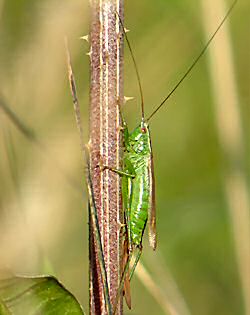
Image by Jack Dennison
Roesel’s Bush Cricket – 18th August
Rob Woodward found a Roesel’s Bush Cricket in E2, near the top of the steps, today. This is a local species, with a generally southern distribution. Also seen was a Water Rail on the Slurry Lagoon.
Bat Patrol – 11th August
Ten People turned up at the main gate at 20.15 to see what bats could be found over the lagoon site. Rebecca Tarry, senior ecologist with SLR Consulting, led the survey and distributed bat boxes to those who did not have them. Bat boxes translate the calls of bats, inaudible to humans, to a sound within the range of human hearing. Some of the boxes were set to different frequencies so that as broad a range of bats as possible could be detected. Rebecca explained to us how the different bats sounded and how some use harmonics, so that the lower harmonic of one bat’s call and the higher harmonic of another could both be picked up with the bat box tuned to one frequency.
We walked along the top of the Slurry Lagoon bank, towards the river but, as the bats frequently wait until about twenty minutes after sunset to start feeding, we did not pick up any calls. At the corner of the Deep Pit, by the river, Rebecca placed an Anabat box to scan the Deep Pit water surface below. This device records the bat calls in bursts of a few seconds so that they can be analysed later on a computer with a programme that produces sonograms. Each bat’s sonogram is unique to its species, except for a very few Myotis species which are very difficult to separate. We left the box where it was and continued around the top of the Deep Pit. As we walked along two Common Sandpipers, which had been calling on the river, flew past us and on the Deep Pit the Tern platforms, which we thought had been deserted since the Terns finished breeding, were being occupied by roosting Terns.
We carried on around the Deep Pit and then past the Slurry Lagoon, where the Starling roost could be heard as its occupants quarrelled over perches in the deepening gloom. In the background the calls of gulls and geese could be heard as large flocks of them were also coming in to roost. We arrived near the footbridge, with still not a whisper from any bat although there were plenty of insects about, when someone suggested standing on the bridge for a while as they had seen Pipistrelles here in the past. Soon a Pipistrelle was heard giving its peculiarly ‘wet’ sounding clicks, and then another call identified as a Noctule. Another bat was then seen flying silently in the half light between two hedges. Rebecca explained that bats in fact have very good eye-sight and, where they know there is an open space, they do not need to echo-locate, in fact there is nothing there to catch an echo from. Pipistrelles fly in a very erratic way, with lots of twists and turns and often forage on insects attracted to lights. They are very small bats, their body being no bigger than the top joint of your thumb, but they need several thousand gnats or midges a night to keep them in good condition. There are two species of Pipistrelle which were only separated when bat boxes were invented. One calls at a frequency of 45 and the other at 55, called the Soprano Pipistrelle. People then realised that the bats calling at these frequencies formed discreet populations and were in fact two different species. Noctules are much larger bats and can be seen flying at dusk (or even in the middle of the day), sometimes mingling with Swifts as they make aerobatic stoops to catch large flying insects like cockchaffers or large moths.
Willow Walk promised to give some good bat foraging opportunities so we walked along its length but only picked up two more Pipistrelles before we were back by the gates. We now walked along the Lower Path, back towards the river, getting more Pipistrelles and a Noctule flying over. At the Railway Bridge the bat boxes started to pick up a new sound, much ‘drier’ than the Pipistrelles, and Daubenton’s Bat was identified. Rebecca switched on a very powerful torch and the Daubenton’s were seen flying through its beam very low over the water. She told us that Daubies use their feet and tails to catch insects close to or on the water’s surface. The torch beam was thick with flying insects, so there was abundant food for bats, but there were not many bats around. Rebecca then saw another bat in the beam that didn’t behave quite as the Daubenton’s were and provisionally identified it as a Natterer’s Bat. More Pipistrelles, including Soprano Pipistrelles, and Noctules were also found here so the river was definitely the most productive site for bats so far.
We didn’t expect to get a great deal more now so we went back up the Deep Pit bank to retrieve the Anabat box. The bat boxes could detect Pipistrelles and Daubenton’s over the water and these were soon picked out in the beam of the torch. Having retrieved the Anabat box we made our way along the top of the bank towards the gates. Bat activity faded as we got further from the river and we picked up none once we were walking by the Slurry Lagoon. This brought us to the end of our survey so we returned to our cars, Rebecca saying she would analyse the recordings she had made and let us know the results.
Sawfly – 11th August
A Brown Argus was found at the car park end of the Slurry lagoon and the Hobby was seen again, being mobbed by Swallows.
An exciting new find by Marion Bryce was a sawfly, Abia sericea, which has not been recorded in the area before.
Spotted Flycatchers – 9th August
Six to eight Spotted Flycatchers were seen today as one or two families moved through on migration. They were seen along the Railway Embankment and by the Railway Bridge. At the Bridge were a large gathering of Hirundines, including at least 100 Swallows, which were spooked by a Hobby.