Category Archives: Uncategorized

National Moth Night 15th May 2010

National Moth Night is a yearly event where, all over the UK, people go out and light up the sky and identify the moths in their local area. The date of the National Moth Night varies each year, as does the purpose of the night. Sometimes it targets a specific species during their flight times or a change in general distribution. This year it has been about moths and their predators: bats.

Moths, like butterflies, like to fly in warm and calm conditions. After a chilly weeks weather, Saturday had been reasonably pleasant and warm. We arrived at 8pm and the sky was clearing with a fairly strong breeze. It is always relaxing to watch the sun set to a chorus of Sedge Warblers and Cuckoo. A party of Common Tern came into roost and a Peregrine skimmed through at dusk across the Deep Pit.

We had two lights operating and decided to trap between the Slurry Lagoon and the Deep Pit. One trap on the junction between the track between the two pits and the outer path and the other a little along the track between the two pits. Lights went on about 9:10 and activity was slow at first, although three to four Noctule Bats hunted over the Slurry Lagoon. While I stayed with the equipment the group walked to the River Trent where Daubenton’s Bats and probably Soprano Pipistrelle Bats were feeding.

Before long the first moth appeared, luckily caught as it was just about to disappear. A lovely fresh Waved Umber, whose food-plant is Privet and Lilac. Then came the very variable Shuttle-shaped Dart with Rusty Shoulder Knot. A lovely male Pale Tussock was then followed by a cracking fresh Mullein Moth. This species feeds on Mullein and Figwort. Then came a fresh Green Carpet and the dashingly dark Spectacle, a moth you need to look head on at to see its large two pale disks below a quiff of hairs!

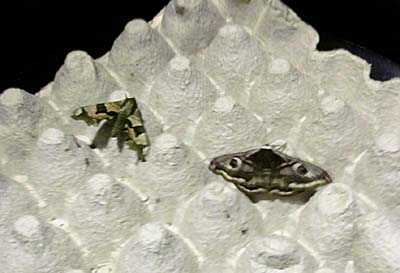
Activity around new Robinson trap had appeared to be quiet but to our delight, sitting just below the bulb was the star moth of the night, a lovely female Emperor Moth, the UK’s largest moth. Although the caterpillars have been found in the past, until now, no one had seen the adult. Camera phones were used to capture this event.


Although only a few yards away the Robinson trap yielded completely new moths. In addition to the Emporer Moth, a stunning male Lime Hawkmoth, a lovely Pebble Prominent and a Flame Shoulder.

At midnight the group made its way home under the stars to the back drop of a reeling a Grasshopper Warbler, all very satisfied at seeing this new aspect of Netherfield Lagoons.

As we have new mothing gear I hope to arrange a number of mothing evenings throughout the year and I hope members and their friends and family will join us. All you need is a torch, warm clothing and seat to sit on. As it’s important to choose the right evenings, I will post the nights up on the website a day or two before, so please keep your eyes open. If you don’t have internet access but would like to come let me know your phone number and I will phone you beforehand. You can contact me on 9893197.

Look forward to seeing you there. Craig Howat.

Wirral trip report – 28th March 2010

Six men in two cars left Newstead at 7.15 am for the Wirral. On the way over we stopped briefly at Goyt Moss to look for Red Grouse. We had hardly stopped when Tony found at least one. Meadow Pipits were also seen. Continuing on our way we arrived at our first stop at 9.30 as arranged with Stuart Taylor, one of our earliest members who now works for the RSPB at Lake Vyrnwy, mid-Wales. The trip list was now on 10 as Raven, Jay and Sparrowhawk were seen en route.

After a short break to stretch our legs we set off to our first watching point – Heswall Banks. Stuart T, not confusing him with Stuart Pryor, suggested a short walk here but on seeing the high tide (9.1 metres) told up that was impossible as the pathway was under water. We settled down to watch the marsh as the tide was still coming in and moving the birds in front of it. Over 1000 Redshank, along with hundreds of Shelduck and other waders were being forced up the marsh by the advancing tide. A female Hen Harrier was seen as was a Grey Plover and many Little Egret. Around the area we also saw and heard Chiffchaff. With the list now on 29 we headed back up the Wirral to Parkgate, a well known watch point on the marsh when there are exceptionally high tides of over 10 metres. These happen about twice a year but not today. (I’ll have to sort a trip out for that).

Similar birds were seen here as at Heswall Banks but Stuart T, had inside information that there was a Spoonbill further up the marsh so we walked up and had superb views of an adult. Buzzard was also seen. A Marsh Harrier was seen by some of the group.

With the list now standing at 38 we moved on again, this time to the RSPB Inner Marsh Farm. This is a fairly large reserve but at present with only one hide and a very small car park.

Treecreeper was heard in the car park by Steve and Pete heard our first Willow Warbler of the year, good views of which were had later on. We had good views of Raven, Buzzard and Peregrine Falcon. We also saw Black-tailed Godwit, Ringed Plover, Little Ringed Plover and Ruff.

There was a distant group of Sand Martin and I managed to see one House Martin among them. Three Spotted Redshank and a single Greenshank were also seen. As we made our way back to the car park some of the group thought they had heard a Lesser Whitethroat but it couldn’t be located. There was a large herd of swans in the distance and it was reported that there were Whooper and Bewick’s among them but we couldn’t make them out. Rabbit and Grey Squirrel were seen on the way to the car park taking the years Mammal list to 5.

We had had a wonderful day in good company and were looking forward to the next trip.

The day list stood at 66 with 28 of these being added to our annual trip list. That list now stands at 111 compared with 85 this time last year.

Carsington Water – Sun, 7th March 2010

The weather forecast for the previous weekend was horrendous with high winds and blizzards. We decided to postpone to the following weekend. As it happened the bad weather missed us.

We met up at Newstead, two car loads and made our way to Cromford were we eventually had good views of 4 Hawfinch in the car park area.

With some of the gentlemen going to the loo we arranged to meet on the bridge over the river Derwent to look for Dipper. We had marvellous views and decided to then go on to Carsington when we realised that Jackie was missing. Minutes later my phone rang. It was Jackie asking where WE where. I asked where SHE was – out side the gents’ loo waiting for us, (so she said). Jackie eventually joined us and soon had Dipper on her list. Trip list now stood at 13 for the day.

We arrived at Sheepwash Car Park (the free one) at Carsington Water and made our way to the hides. We soon added Oystercatcher and Great Spotted Woodpecker to the list along with our target bird of Great Northern Diver. We were fortunate to be in the right place at the right time as a herd of Whooper Swan had arrived that morning. Also seen of note were Curlew and Redshank while Raven was heard.

We made our way to the Wildlife Centre calling at the feeding station on the way. Here we added stunning views of Bullfinch, Tree Sparrow, Reed Bunting and Willow Tit. The list now stood at 38 plus Grey Squirrel.

At the Wildlife Centre we added Barnacle Goose – about 50 – plus Ruddy Duck and Goosander. Tony found a Water Rail on the far bank that proved difficult for some of the group to see. A Little Owl was also seen in the hedgerow at the rear of the centre. We were told by a Ranger that that was the first one for quite a while. With the list now standing at 46 we made our way back to the cars and lunch during which we added Common and Herring Gull.

On the same trip last year we called at Swallow Moss and saw a male Hen Harrier so it was decided to go there again. What a disappointment. The only birds seen apart from a few distant hens were two flocks of Starling and one Fieldfare.

Having consulted the maps it was decided to call in at Tittesworth Reservoir – just over the hill. I decided that it would be quicker to go over the hill instead of round it. We got to the top, above the snow line, and a road disappeared. We ended up almost were we had started so we did go round the hill in the end.

On arriving, eventually, at Tittesworth we were greeted by up to 7 Redpoll. We walked to the two hides. Between the hides we were treated to the evocative calls of a flock of over 80 Curlew coming in to feed on the far fields. Lapwings were also seen along with one Common Snipe that was behaving like a Jack Snipe.

As the setting sun shone on the Roaches the Curlew, split now into smaller groups and giving their haunting calls, flew off towards the setting sun.

The days total was 61 plus 2 mammals. The yearly total is now 82 compared with 71 in 2009. The mammal total is 5 compared with 3 last year.

Spurn Trip 25th October 2009

The wind had been blowing from the east for almost three weeks with migrants down the east coast from Scotland to Kent. I decided, upon consultation with the three other people who had shown an interest in the trip – Pete, Jackie and Deryck, to bring the trip forward a week from 1st November to 25th October.

After checking what was about it was decided to call first at Bempton Cliffs RSPB reserve as there was a Red-flanked Bluetail that had been there for two or three days. There had been an influx on the Yorkshire coast for the past 10 days with three reported from Spurn at the same time earlier in the week.

We arrived at Bempton in quite a strong westerly wind to be told – yes it had been seen that morning. We search for almost 2 hours but eventually gave up. We did manage to see a distant Red-backed Shrike, Rock Pipit and Rock Dove.

We left Bempton to go to Spurn calling at Hornsea on the way were 7 Red-Breasted Merganser was seen.

Approaching Spurn 2 Roe Deer were seen in the fields near Kilnsea.

Arriving at Spurn we decided to drive to the point. On the way Knot, Bar-tailed Godwit and Turnstone were seen on the mud. In the dunes early Redwing were seen.

Before leaving we called at the hide hear the reserve entrance where we were treated to two Jack Snipe and Water Rail.

Overall 64 species were seen with eight added to the trip total that now stands at 165.

Skua & Shearwater Cruise, Sunday 20th September 2009

We left Nottingham later than usual at about 8.30 as the boat didn’t sail until 4.00 p.m.

It was decided that we went first to Flamborough Head to see what was there. We arrived at about 11.00 am after a short stop on the way. We had heard that there was a Barred Warbler in the area but were not sure where about. We made a few enquiries and we soon looking at a splendid Barred Warbler.

Three of us decided that we would take a walk round the headland to see what else was about. Brian went back to the car as his leg was still in plaster after breaking it.

We had good views of Red Admiral and Painted Lady butterflies along the road before turning off to go across the fields. It was a hot still day and there was not a deal about until we reached the cliffs were Shag and a few waders were seen. As we walked along the cliff top path we noticed a group of birders looking into the field on our left. Upon reaching then we realised a juvenile Great Skua was sitting in the middle of the field. After a search of over half an hour we found singles of Lapland Bunting and Snow Bunting.

After lunch in the car park we made our way to Bridlington for the boat, hoping to see Purple Sandpiper on the harbour walls but to no avail. As we were waiting to board the boat we were surprised to be joined by Pete Smith and his wife, Chris.

The boat trip was very quiet with only a single Shearwater that was not seen by most people but a single Great Skua that gave us great views of how it chased and harried birds for them to discharge their food.

Gannet, Kittiwake and Fulmar were added to this years trips list making a total of 157.

Grey Seal was added to the mammal list while Red Admiral was added to the butterfly list.

Wildlife I.D. Courses

Karen Bennett who is Nottinghamshire Wildlife Trust’s Education and Community Manager has asked us to let you know that Attenborough Nature Centre are holding short one day wildlife i.d. courses as well as half day walk and talks. More information can be found on their Web Site.

Patchwatch Day – 27th September 2009

Each Patchwatch I tell myself there is no point arriving before dawn as I won’t get an owl anyway. I snuggle under the covers for another hours kip but then think, ‘Yes, but what if there is an owl there and I miss it.’ So I find myself stumbling around in the dark at 05.30 again wondering where I left my common sense. All I can hear is Robins, they seem to be singing or ‘ticking’ from every other bush, the ‘Bird Count’ days never record this many Robins.
I walked along the Lower Path towards the river, to the accompaniment of the Robins, and then, in the distance, I heard a cacophony of Jackdaws. By the time I reached the river I had two entries on my bird list. I climbed the bank to peer down into the gloom of the Deep Pit and startled a Heron, which in turn startled the Coots and Canada Geese that were roosting there. As I walked along the Deep Pit bank towards the northern corner the geese settle down again, its still too early for them to be up. I continued along the northern edge of the Deep Pit and approached the Slurry Lagoon and gradually became aware of the squeaks and quacks of the Gadwall, but could make out nothing else in the darkness. Halfway along the Causeway I heard the distinctive calls of a Green Sandpiper and then a second one was calling, I stopped to listen and caught the sounds of Mallard and Moorhen and could just see the forms of Mute Swans. More listening produced Reed Bunting, Carrion Crow, Snipe, the whistles of Teal and the squeals of Water Rail, of which five or six were calling. The Lesser Black-backed Gulls in the roost started to wake up and call as I reached the railway end of the Causeway and a Wren was singing.
The sky was lightening in the east now and I no longer needed my torch to make my entries. A startled Blackbird gave its alarm call as I turned right at the corner to walk towards the Car Auction end of the site. Suddenly a Tawny Owl gave a shrieking hoot almost in my ear, followed by the more normal quavering note, it then flew past me across the pale eastern sky, into the Deep Pit. Wow, an owl at last. It was now 06.30 and the score had reached nineteen.
As the light grew brighter so more birds began to give themselves away with calls and songs. Dunnocks were ‘seeping’, a Blackcap was ‘tacking’ and Black-headed Gulls were screaming as they flew overhead. Then I heard the unexpected ‘churring’ alarm of a Whitethroat, I thought they had all gone. I rapidly added Rook, Magpie, Chiffchaff and Starling to the list and now I could see as well as hear birds and Great Tit, Chaffinch, Blue Tit and Pied Wagtail swelled the numbers. In the bushes near the Footbridge a Chiffchaff was calling and I looked in an elder bush to try to see it. To my surprise a Reed Warbler was hopping amongst the branches, another bird I thought had already left for Africa. I was now walking east along the north side of the Slurry Lagoon, with Wood Pigeons flying from their roost along with several Chaffinches, and on the Slurry Lagoon I could now see Shoveler Little Grebe and a few Herring and Great Black-backed Gulls in the gull roost. I turned the corner onto the Causeway again and saw a Great Spotted Woodpecker fly into the Ash Trees, beyond the Plantation.
As I walked along the Causeway I could see Neil and Paul Matthews coming towards me and they said they had just seen a Jay near the Signal Box and a Kingfisher on the river. As we swapped notes we were also spotting new species and Grey-lag Goose, Greenfinch, Tufted Duck, Pochard, Pintail and Feral Pigeon brought the tally to forty-five by 07.30.
I wanted to see the Jay, so set off to look for it and soon found it near the Railway Bridge. I wanted to see this bird as it is a rarity on the site and so it was with pleasure that I heard its raucous screams and saw its clumsy flight as it moved along the railway line trees. I hadn’t seen a Great Crested Grebe yet, so I walked along the Deep Pit bank again, looking over the Large Gravel Pit until I spotted my quarry, two adults and two well grown young. On the way a Cormorant flew over but I claimed no other new species until I again reached the end of the Causeway. Here in the bushes on the inside slope of the Deep Pit I found two Sedge Warblers with a flock of Great and Blue Tits. On the Causeway I met up with Neil and Paul again and I told them about the Sedge Warblers. Just then a Kingfisher flew along the far side of the Slurry Lagoon, before perching on a reed stem. Neil put his telescope on it so that we could all see it well. Overhead some Skylarks were flying south on their way to more temperate climes, and later some Meadow Pipits. Some Lapwings flew in to rest on the slurry and a Goldfinch flew over, while a Cetti’s Warbler interjected its unmistakable staccato notes from deep within some nearby bushes. Paul and Neil could not stay any longer so I walked with them along the north side of the Slurry Lagoon towards the footbridge, gaining Grey Wagtail and Long-tailed Tit on the way. It was now 08.30 and I had recorded 57 species.
On the path I met Paul Beresford and stopped to chat while Neil and Paul went off, I then carried on alone following their direction, meeting Jackie Dennison as two more Jays flapped their way across the dry end of the Slurry Lagoon. Jackie carried on towards the Causeway and I continued towards the Footbridge, next meeting Rob Woodward as he made his way onto the site. The numbers of new people arriving would help to swell the numbers of birds on the list but today I wanted to see all of the species myself if I could. I continued alone around the western end of the Slurry Lagoon, catching the maniacal laugh of a Green Woodpecker on the way. I really wanted to get Willow Tit on the day list if I could so I aimed for the Lower Path again as this is normally the best place to catch up with them. I had just started walking along towards the river again when the gaggle of geese overhead drew my attention to a skein of about sixty Pink-footed Geese, flying west, probably between the Wash and the Ribble estuaries. A little further along the path a ‘tack’ call, a little less harsh than a Blackcaps, alerted me to a Lesser Whitethroat and I saw two of them chase each other around a bush. Alas, no Willow Tit, but I did meet John Feeney and Tony Lowry near the Irish Bridge. They had also seen the geese go over but had nothing new to add. Paul Beresford approached us from the river, but had missed the geese. As he joined us first Song Thrush and then a Linnet flew overhead. John, Tony and I carried on towards the Railway Bridge. It was now 09.30 and the list had reached 62.
At the bridge a Stock Dove was sat on the wire on the other side of the river but there was no sign of any of the summer’s Swallows that had been here feeding young only a week before. We walked back up the Deep Pit bank, splitting at the top so that I walked anti-clockwise round the Deep Pit while John and Tony went clockwise. By the time I got round to the Causeway again to meet Rob I had only added Collared Dove to my total. Rob had missed the geese but then found another skein of about forty-five flying across the fields. He had found a Dunlin on the Slurry and a distant Buzzard was seen circling over the fields. Pam Gartside ‘phoned me up to tell me about the Buzzard, and later joined us on the Causeway but new birds were now very difficult to find. After a while I decided to go home for some lunch and went via the Lower Path, hoping to get a Willow Tit on the way, and Pam joined me. We didn’t get the Willow Tit but did hear a Siskin’s plaintive call as it flew by. A young lad on a motorbike was being particularly annoying as he buzzed round the pits. I managed to stop him and told him to leave the site before I called the police. He moved onto the railway land and I hoped he might flush a Willow Tit in our direction, but it didn’t work. Instead he met two friends which gave him the courage to come back on site. I ‘phoned the police and the youths left and while we waited for the police to respond the Lapwings all took off from the Slurry Lagoon, shortly followed by all the Feral Pigeons. We both searched the sky for a raptor and high in the sky over the river our efforts were rewarded by the sight of a spiralling Peregrine. As we didn’t hear from the police we went our separate ways to get some lunch. The score now stood at 68, at 12.30.
I came back on site at about 15.00 and walked again along the Lower Path, searching for a Willow Tit. It wasn’t long before a Yellow Wagtail called as it flew overhead, but the hoped for Willow Tit was not to be seen. I walked up the Deep Pit bank and along the top between the Deep Pit and Large Gravel Pit, looking down over both and hoping for a Wheatear, Stonechat or Redstart. Instead I found the Aythea hybrid, a cross between a Tufted Duck and a Pochard that looks a little like a Lesser Scaup. On the Causeway I met Rob again, with Philip Burnham. They had seen a Sparrowhawk and the Peruvian Ruddy Duck, and a group of Swallows flew through to the south. Phil and I went for a walk along the river bank and around the far side of the Large Gravel Pit but found no new species so we joined Rob on the Causeway again, along with Pam and Dave Gartside and Jackie Dennison. Rob had found what he thought was a Caspian Gull amongst the gull flock, a rare species on the site as well as a difficult one to identify but it did have very dark eyes, a long parallel bill and pink legs which were good positive indications of its species.
After resting on the bench for a while Phil left us, making his way off the site along the Lower Path. A little while later he phoned us to say he had found a Willow Tit. I set off after him to see if I could get it too as the only addition to the list in an hour had been a Pheasant that Jackie had heard earlier. There was no sign of a Willow Tit, but I did find a Sparrowhawk as I made my way off.
An hour or so later Rob ‘phoned me to say after I left a Common Gull flew in and two Ruddy Ducks had appeared, bringing the day’s final total to 78.
Butterfly Walk 23rd August 2009


Small Tortoiseshell
Small Tortoiseshell

A very warm and sunny day slightly spoilt by a strong south westerly breeze which kept the butterflies from flying. A group of seven of us set off along the Ouse Dyke where we encountered the usual selection of large, small and green-veined whites, speckled wood butterflies along with common darter, brown hawker and southern hawker dragonflies. We were even greeted by the call of the resident kingfisher as it speed off up the path.

On entering the site we soon found the first of our target species of common blue, which it became apparent are very abundant all around the site as there is plenty of birds-foot trefoil on the bank tops and sides. The next of our target species for the day was the small copper, only one of these was located at the top of a bank I know from previous visits to be one of the best places to find them. Unfortunately we weren’t so lucky with the small heath which failed to show at all, probably due to the wind whipping across the site.

Dropping down to the river bank to get some shelter from the wind we encountered our next target, brown argus. Or at least the back markers did, by the time the rest of us had backtracked it had disappeared into the long grass. However, we did all get to see this small butterfly later as altogether we encountered six in various parts of the lagoons.

The walk continued in the shelter of the hedge bordering the back of the gravel pits where plenty of common blue damselflies along with other butterflies and dragonflies were taking advantage of the windbreak offered by the hedge. Our return to the site found more brown argus on the central bund between the deep pit and the slurry lagoon, and also along the bottom pathe following the railway line.

By the end of the walk we had encountered ten butterfly species, including those mentioned above along with small tortoiseshell, brimstone, meadow brown and painted lady. Other highlights included two hobby, wheatear, whinchat and various warblers.